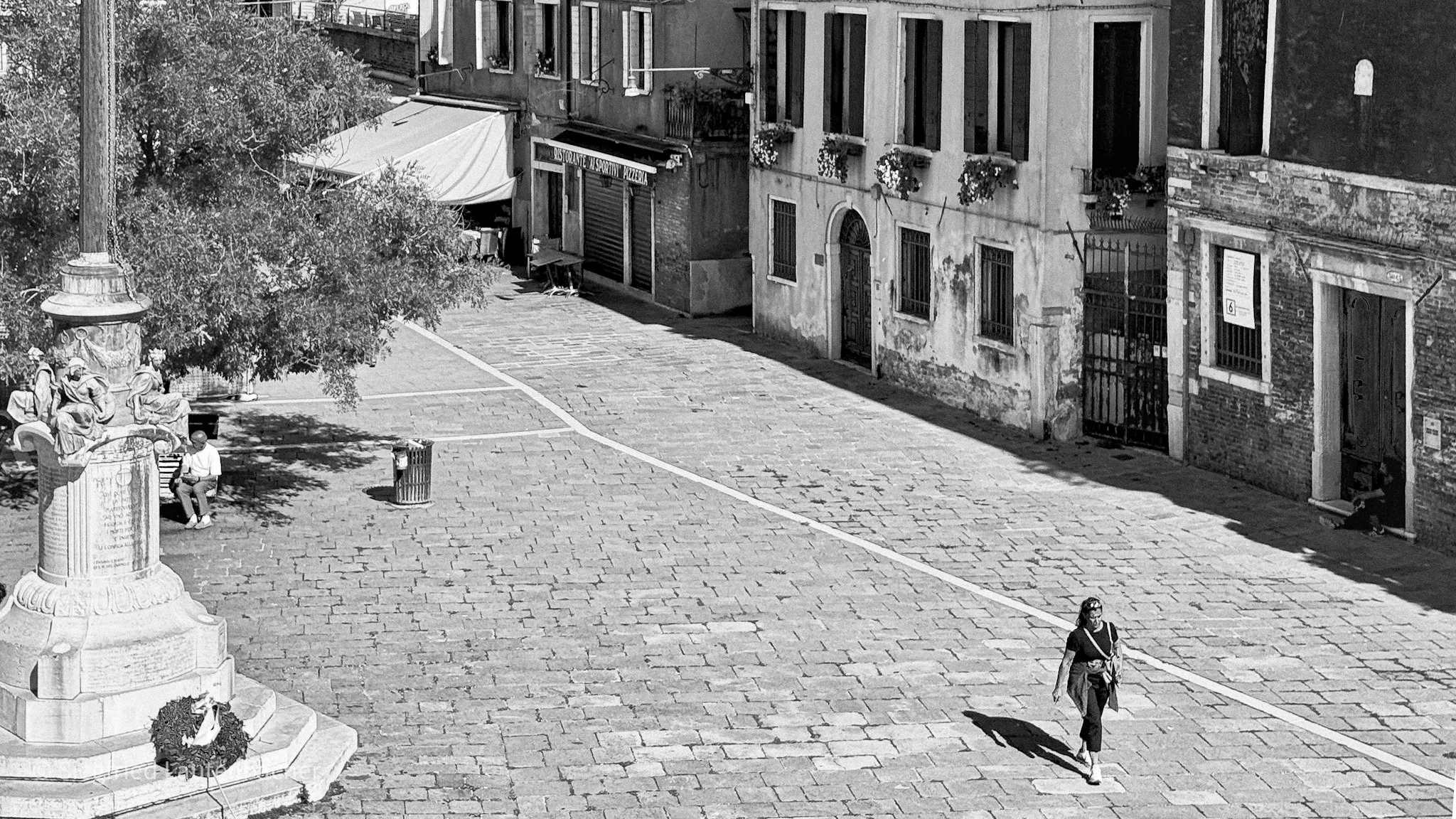
Levinas’s “living from”, seen in a concrete scene
Across the campo, a man sits in a doorway in the shade, his gaze fixed on the rubbish bin near a pizzeria. Every time someone throws away a piece of pizza, he gets up, retrieves it, and returns to his shaded spot to eat it with evident enjoyment. The seagulls watch him suspiciously—this is their hunting ground he's raiding.
This small scene at a Venetian campo reveals in living detail what Emmanuel Levinas philosophically describes as "living from" and where Corine Pelluchon places her decisive critique.
Venice, August 2025. Campo Santa Margherita
Venice, August 2025. Campo Santa Margherita
The doorway is more than mere “accommodation”—it has become a dwelling. The man hasn't chosen this spot randomly: it offers shade (protection), overview (control), and strategic proximity to the food source. Here he finds what Levinas calls refuge—a place where he can “have a certain intimacy, gather himself.” Even under extreme conditions, this fundamental structure of human dwelling emerges.
This isn't the romantic ideal of one's own four walls, but the existential basic structure: every person needs a place that is more than function—a place that enables dignity.
The man doesn't constitute his nourishment—he receives it. He “bathes” in the possibility of the discarded, is immersed in a system of touristic waste without comprehending or controlling it. His existence follows the rhythm of other needs, other saturations.
And yet: he eats with enjoyment. The discarded pizza slice doesn't become mere “fuel” (as Marx described the alienated nourishment of workers), but retains its “savour.” Even under extreme deprivation, that “dimension of enjoyment originally connected to the fact of living” emerges, which Levinas sets against philosophies of thrownness and being-toward-death.
Life is more than survival—it is living-from, and living-from is enjoying.
But there are the seagulls. With their suspicious observation, they reveal something Levinas overlooked: there is no “egoistic innocence” of enjoyment. “Living from” is never merely individual, but always already relational, competitive, ecologically entangled.
Corine Pelluchon's critique becomes visible here: “Our use of food is ethical from the start” because it affects other living beings. The man cannot enjoy innocently—every bite he takes is one less for the seagulls. The discarded food belongs to an urban ecosystem where humans, birds, and rats compete for the same resources.
The seagulls are the living refutation of Levinas's separation between the “world of nourishment” and the “ethical world.” There is no pre-ethical space of elemental life. Every “living from” is already “living with”—and thus ethically entangled in the asymmetries of global tourism.
This small scene shows why Venice is an ideal place for philosophical reflection. The city itself embodies the dialectic of inside and outside that Levinas describes: canals as elemental bathing, islands as refuge, bridges as places of encounter.
But Venice also reveals the ecological limits of any philosophy of nourishment. The city is sinking because too many people want to “live from” it. Overtourism makes visible what Pelluchon develops theoretically: in a finite world, there can be no innocent receptivity.